
Comparative Engineering Review: Assessing the Dynamic Performance and Energy Efficiency of the Ford Mach-E GT, Hyundai Ioniq 5 N, and Tesla Model 3 Performance

As an Electric Vehicle Performance Engineer and Comparative Test Analyst, this report dissects three key contenders in the high-performance electric vehicle (EV) segment: the Ford Mustang Mach-E GT Performance, the Hyundai Ioniq 5 N, and the Tesla Model 3 Performance. These platforms offer comparable sizing and market positioning, yet diverge significantly in their engineering philosophies regarding power delivery, thermal management, and driver engagement. The subsequent analysis focuses on empirical testing data and system design choices to determine which vehicle offers the most compelling balance of dynamics and utility.
I. Energy Efficiency and Range Metrics
In the high-performance EV sector, the trade-off between power output and operational efficiency is a critical design challenge. Testing these three vehicles under controlled conditions (the EV Range Test protocol) revealed the variations in their energy management and aerodynamic profiles:
- The Tesla Model 3 Performance demonstrated the superior range envelope, achieving 307 miles on a full charge, benefiting from its optimized sedan form factor and lower mass.
- The Ford Mustang Mach-E GT Performance followed with a credible range of 280 miles, reflecting the added aerodynamic resistance inherent in its crossover-SUV architecture.
- The Hyundai Ioniq 5 N recorded 253 miles, an expected outcome given its robust, high-output calibration and focus on track-readiness over maximum highway efficiency.
While the performance variants inherently sacrifice some range compared to their Long Range counterparts, the deficit is less severe than anticipated. The difference between the Model 3 Performance and the Long Range variant was only 31 miles, indicating effective system integration. The Mach-E RWD extended range variant achieved 341 miles (a 61-mile delta), illustrating the aerodynamic and weight penalty incurred by the GT variant's AWD and larger wheel/tire package.

II. Longitudinal Acceleration and Power Delivery Assessment
Acceleration is the primary metric for defining high-performance EVs, often leveraging the instantaneous torque delivery of the electric motors. The data reveals distinct differences in calibration and power-to-weight ratios:
- The Tesla Model 3 Performance secured the fastest 0 to 60 mph time at 3.0 seconds flat. This is attributable to its optimized thermal management for brief, high-power bursts and its relatively lightweight design.
- The Hyundai Ioniq 5 N, despite its higher curb weight, was exceptionally competitive, achieving a 0-60 mph time of 3.3 seconds. The Ioniq 5 N benefits from the N Grin Boost (NGB) feature, which temporarily increases its already substantial 601 horsepower output, demonstrating highly effective electronic torque vectoring off the line.
- The Ford Mustang Mach-E GT Performance recorded the slowest time at 3.7 seconds. While quick, its heavier, elevated platform contributes to a noticeable difference in perceived acceleration compared to its competitors, despite recent powertrain revisions including an upgraded rear motor calibration.
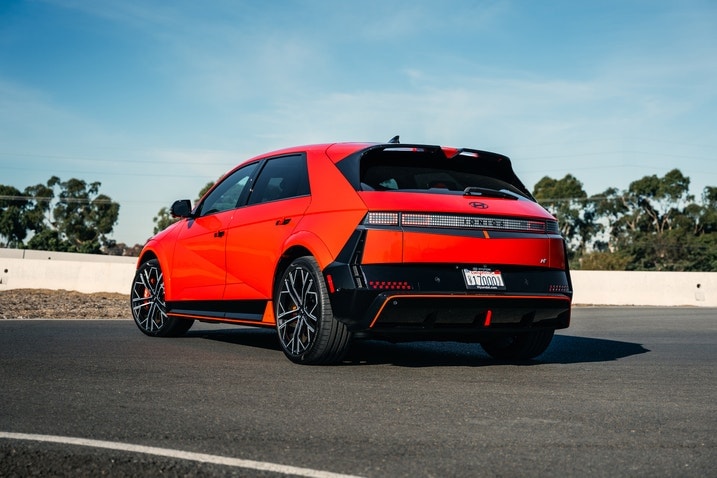
III. Chassis Dynamics and Driver Engagement
Beyond raw speed, the subjective "fun" factor is determined by steering responsiveness, body control, and the level of driver engagement provided by the control systems.
A. Tesla Model 3 Performance
The Model 3 exhibits precise handling, characterized by solid steering feel and excellent body control. Its design is inherently superior for track use due to its low center of gravity and sedan profile. The inclusion of track-specific software, such as the *Drift mode* (which deliberately reduces stability control parameters), provides experienced drivers with the capability to explore the vehicle's dynamic limits through controlled oversteer maneuvers.
B. Ford Mustang Mach-E GT Performance
The Mach-E GT, despite its performance aspirations, suffers from the inherent compromises of its high-riding crossover design. Cornering dynamics reveal increased body roll and a less immediate connection to the road surface compared to its lower-slung rivals. Although equipped with high-specification hardware, including Brembo brakes, the platform’s greater mass and elevated ride height detract from its ultimate track capability.
C. Hyundai Ioniq 5 N: The Engineered Engagement
The Ioniq 5 N distinguishes itself through deep engineering focused on maximizing driver feedback. Although heavier than the Model 3, its chassis calibration expertly disguises this bulk, resulting in highly effective and confidence-inspiring handling. Its major differentiator is the electronic simulation suite, which includes simulated gear shifts and synthesized engine acoustics. This system taps into the psychological enjoyment of traditional high-performance driving, creating a sense of mechanical engagement often missing in silent, single-speed EVs. The cockpit is intentionally designed for performance, featuring highly supportive seating and a specialized digital interface.

IV. Software Integration and Customization
The role of software in these performance EVs is multifaceted, defining both the user experience and the available dynamic modes.
A. The Ioniq 5 N Ecosystem
The Ioniq 5 N offers an extensive, near-endless array of customization parameters, enabling the driver to fine-tune steering, suspension damping, power delivery mapping, and electronic stability control thresholds. This complexity is managed through dedicated N buttons on the steering wheel, allowing for quick recall of customized track or road profiles. This degree of granular control caters directly to the experienced driving enthusiast who prioritizes personalized dynamic setup.
B. Model 3 Utility and Packaging
The Model 3, while updated, remains fundamentally constrained by its 2017 sedan architecture. While the exterior and systems are refined, the interior packaging, particularly the rear passenger area, is noticeably tighter when compared to the roomier, hatch-like proportions of the Ioniq 5 N. Conversely, the Model 3 excels in infotainment and connectivity features, being the only one offering a secondary screen for rear occupants.
C. The Cost of Unlocked Performance
Expert Augmentation: A noteworthy point of contention is the Mach-E GT's pricing structure, which mandates an additional expenditure for the Performance Upgrade software to access its maximum power envelope. From an engineering perspective, withholding pre-installed hardware capability behind a separate transactional paywall—analogous to locking away engine cylinders—is a divisive strategy that creates a negative perception of value and transparency, regardless of the vehicle's base capability.
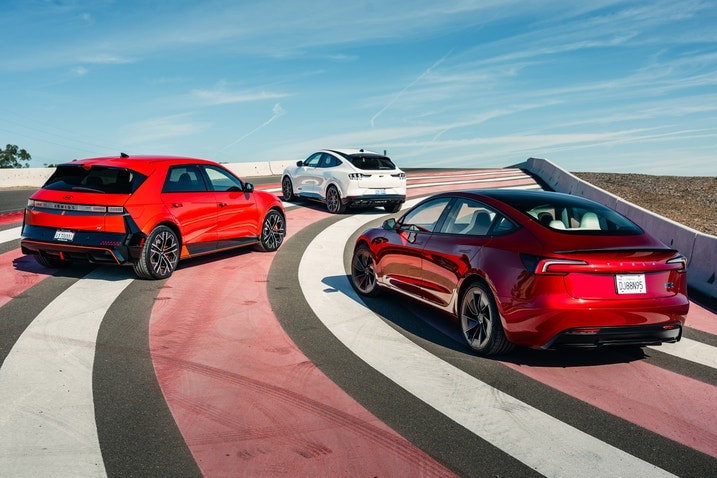
V. Conclusion and Comparative Ranking
While all three platforms significantly advance the state of performance EV technology, a distinct hierarchy emerges based on the fusion of empirical data and driver engagement factors:
- Third Place: Ford Mustang Mach-E GT Performance. Although a commendable vehicle, the Mach-E GT struggles to offer sufficient dynamic separation from its standard variants to justify its status as a dedicated performance model, especially given its architectural constraints and software monetization strategy. Its strengths lie primarily in commuting and daily usability.
- Second Place: Tesla Model 3 Performance. The Model 3 is the pragmatic performance champion. Its superior longitudinal acceleration, market-leading range, and access to a robust charging network make it the most efficient and practical choice. Its handling is agile and precise, securing its status as a highly effective performance tool.
- First Place: Hyundai Ioniq 5 N. The Ioniq 5 N earns the highest distinction by prioritizing driver engagement through engineered features. Its practical body style is versatile, and its complex electronic suite—including the simulated gear shifts and noise—successfully bridges the emotional gap between traditional high-performance internal combustion vehicles and modern EVs. For the enthusiast seeking maximum feedback and driver involvement, the Ioniq 5 N represents the most successful performance calibration.
VI. Interactive FAQ: Electric Performance Platforms
What is the primary engineering challenge for the Mach-E GT's performance?
The primary challenge stems from its crossover-SUV architecture. Compared to the sedan/hatchback competitors, the Mach-E GT has a higher center of gravity and greater mass, which inherently contributes to increased body roll and reduced lateral agility during high-G cornering, placing it at a dynamic disadvantage in track-focused comparisons.
How do simulated gear shifts enhance driver engagement in the Ioniq 5 N?
The simulated gear shifts and acoustic feedback systems in the Ioniq 5 N are engineered to provide a psycho-emotional connection often associated with traditional rallying or track driving. By mimicking the sensory feedback of torque application changes and audible engine noise, the system creates the perception of mechanical interaction, making the driving experience feel more interactive and engaging than a standard single-speed EV.
How significant is the range sacrifice in performance EVs compared to long-range variants?
The range sacrifice is surprisingly modest in most cases (e.g., 31 miles for the Model 3). The reduction is primarily due to the increased parasitic losses from larger, stickier tires, higher power output mapping, and the necessity to dedicate more energy to thermal management systems to keep the battery and motors within optimal operating temperatures during aggressive driving.
Posting Komentar untuk "Comparative Engineering Review: Assessing the Dynamic Performance and Energy Efficiency of the Ford Mach-E GT, Hyundai Ioniq 5 N, and Tesla Model 3 Performance"